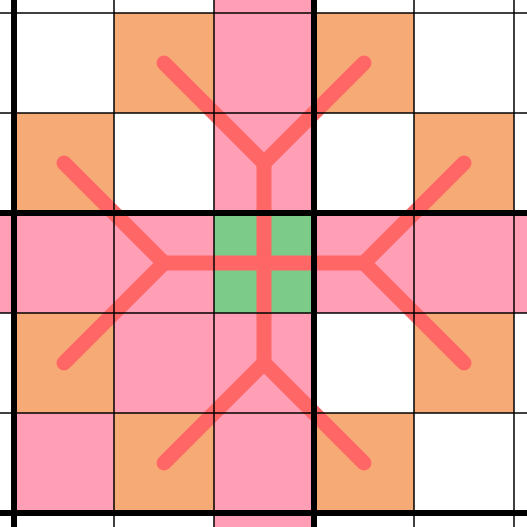
 Chess knights move in an L shape: two squares in one direction, then one square perpendicular to that.
A sudoku Anti-Knight constraint is applied globally and means that no digit repeats in any cell a chess knight’s move away from itself. In practice, this adds up to eight additional restricted cells to each placed digit, marked in orange here.
So many movie execs seems afraid to be honest about how many times they’ve gone back to that well for more money. It wasn’t Die Hard 3, after all. This is DoubleDoku 3, and it’s my favorite so far, but now I’m determined to mimic the silly names movie execs have come up with.
An Irregular Sudoku grid with a non-contiguous region is possible, but usually there can be only one, else how to determine to which region the errant cells belong? I’ve kept these connected, albeit tenuously, and the resulting shapes seem like botanical pixel art.
The shapes look a bit like Oklahoma if you’re generous, and because people who illegally rushed in to claim land ahead of the official opening of the legal theft of Oklahoma land in 1889 were labeled “Sooners,” a name the University of Oklahoma adopted for all future sports teams in 1908.
I spend all my creativity on the puzzles, leaving nothing for the names.
The game of Morra (aka Odds and Evens) is pure luck. Not this puzzle!
Given digits can be friends! Who needs lines or dots or cages when you have great big digits? Well, great big digits and a global constraint.
Some people seem fixated on Inuit people having many words for snow, but English does too! From blizzard to whiteout, with flurries, graupel, and drifts, we have so many words. The one this puzzle’s palindrome lines make me think of is sleet.
I regularly publish 9x9 Sudoku puzzles filled with 3x3 blocks of cells, but this one isn’t regular at all. It’s an Anti-Knight Irregular Sudoku!
White Kropki dots are simple, and there are only a couple of them. XV clues are more interesting, and there are a lot of those. Still not enough to make it clear how to solve the puzzle, but that’s because of the global constraint. This puzzle demonstrates an overt bias against knights: no knight’s moves allowed!